
Biag ti pammati
- Dagiti Tawen
- 1806–1876
- Bokasion
- Daughter of Charity
- Pananglagip
- 28 November · Vincentian calendar
Faith in the midst of ordinary responsibilities
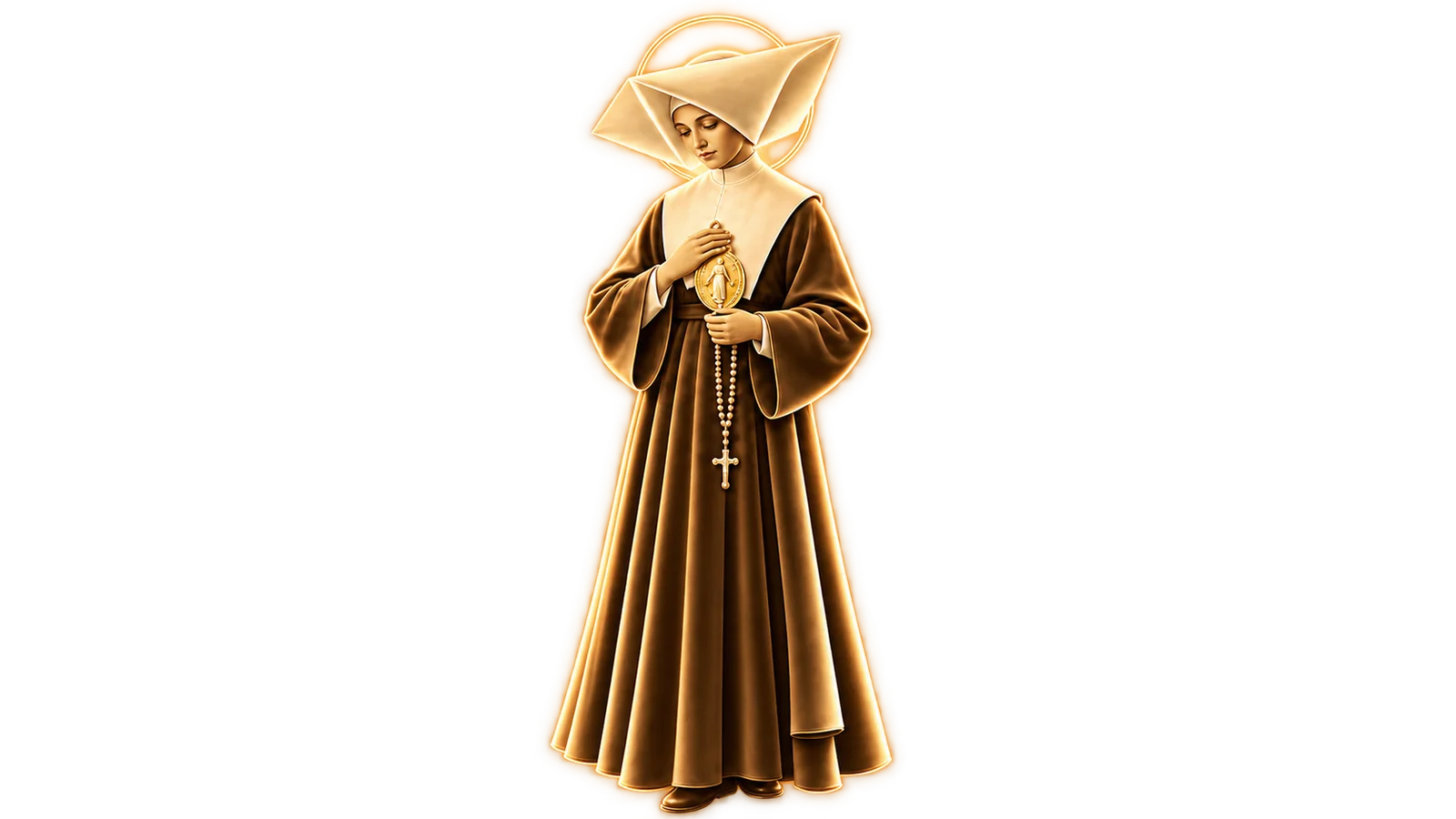
Catherine Labouré was born on 2 May 1806 at Fain-lès-Moutiers in Burgundy, France. Her mother died in 1815, when Catherine was nine. Family responsibilities and farm work became an important part of her upbringing, alongside an increasingly deep life of prayer.
Her desire to become a Daughter of Charity encountered opposition from her father. She persevered and entered formation in Paris in April 1830. The community founded by Vincent de Paul and Louise de Marillac offered a vocation in which prayer and service belonged together.
Source: Daughters of Charity · Life and chronology (French) ↗
The reported apparitions of 1830
During her formation at rue du Bac, Catherine reported visions and Marian apparitions to her confessor, Father Jean-Marie Aladel. The chapel’s account places the Marian encounters in July, November, and December 1830. The November encounter is associated with the origin of the Miraculous Medal. These events are presented here as Catherine’s reported religious experiences, preserved in the devotional tradition of the chapel.
The medal was circulating by 1832. Catherine did not seek public recognition as the sister connected with its origin. The chapel describes her reserve even as the devotion spread. Her response directs attention beyond personal fame to a life of faith and service.
The long years at Reuilly
In 1831, Catherine was assigned to the hospice at Reuilly. Her work included cooking, laundry, welcoming people at the door, and caring for elderly men. She also accompanied people approaching death. The chapel’s biography recalls her patience with difficult residents and her practical encouragement of newly arrived sisters. These ordinary duties occupied far more of her life than the extraordinary experiences for which she became known.
Death and recognition by the Church
After approximately forty-five years of service, Catherine died on 31 December 1876. She was beatified in 1933 and canonized by Pope Pius XII on 27 July 1947. Her body rests in the chapel at rue du Bac. Her feast is celebrated on 28 November in the Vincentian calendar. Her memory unites Marian devotion with the Vincentian call to recognize Christ in people who need care.
Source: Daughters of Charity · Life and chronology (French) ↗
Living her example today
For reflection: what remains of prayer when nobody is watching? Catherine’s life invites us to bring patience to repeated tasks and attention to people who may feel overlooked. Choose one quiet act of care and do it without seeking recognition. A short daily prayer can help us return to that commitment, especially when the work feels ordinary or tiring.
Kitaen ti pakasaritaan
Saint Catherine Labouré
From the Prayers and Reflections YouTube channel.
Kitaen iti YouTube ↗